

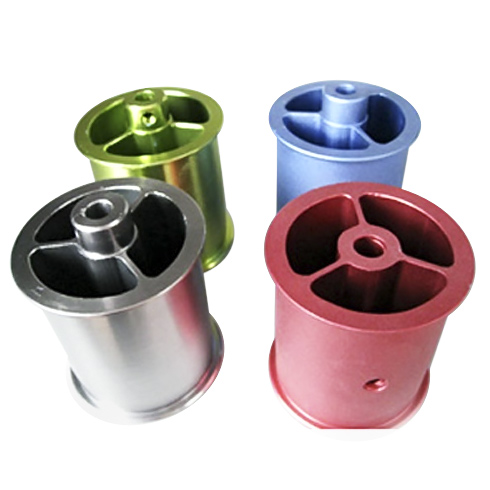
Anodizing is an electrolytic passivation process used to increase the thickness of the natural oxide layer on the surface of metal parts.
Chromic acid anodizing (Type I)
The oldest anodizing process uses chromic acid. It is widely known as the Bengough-Stuart process. In North America it is known as Type I because it is so designated by the MIL-A-8625 standard, but it is also covered by AMS 2470 and MIL-A-8625 Type IB. In the UK it is normally specified as Def Stan 03/24 and used in areas that are prone to come into contact with propellants etc. There are also Boeing and Airbus standards. Chromic acid produces thinner, 0.5 μm to 18 μm (0.00002″ to 0.0007″)more opaque films that are softer, ductile, and to a degree self-healing. They are harder to dye and may be applied as a pretreatment before painting. The method of film formation is different from using sulfuric acid in that the voltage is ramped up through the process cycle
Sulfuric acid anodizing (Type II & III)
Sulfuric acid is the most widely used solution to produce anodized coating. Coatings of moderate thickness 1.8 μm to 25 μm (0.00007″ to 0.001″)are known as Type II in North America, as named by MIL-A-8625, while coatings thicker than 25 μm (0.001″) are known as Type III, hardcoat, hard anodizing, or engineered anodizing. Very thin coatings similar to those produced by chromic anodizing are known as Type IIB. Thick coatings require more process control,and are produced in a refrigerated tank near the freezing point of water with higher voltages than the thinner coatings. Hard anodizing can be made between 13 and 150 μm (0.0005″ to 0.006″) thick. Anodizing thickness increases wear resistance, corrosion resistance, ability to retain lubricants and PTFE coatings, and electrical and thermal insulation. Standards for thin (Soft/Standard) sulfuric anodizing are given by MIL-A-8625 Types II and IIB, AMS 2471 (undyed), and AMS 2472 (dyed), BS EN ISO 12373/1 (decorative), BS 3987 (Architectural) . Standards for thick sulfuric anodizing are given by MIL-A-8625 Type III, AMS 2469, BS 5599, BS EN 2536 and the obsolete AMS 2468 and DEF STAN 03-26/1.